The NIH Estimates 70 Million Americans Have Nerves Running On Empty And Most Blame It On Age
A simple through-the-skin approach is what thousands of people are now using to calm the burning, tingling, and stiffness at the source.

Cindy Driscoll spent thirty-one years teaching fourth grade just outside Lubbock, Texas. She was the one who chased kids around the kickball field. The one who never sat down.
Then, around her late fifties, her feet turned on her.
It started as a faint buzzing in her toes after a long day. She brushed it off. A few months later it was burning. By the time she retired, the burning showed up the second she got into bed.
"Some nights I'd be pacing the kitchen at two in the morning," she says. "Cold tile felt like the only thing that helped."
She saw doctors. She got the shrug. She got the line everyone over sixty seems to get: it's just your age, learn to manage it.
So she tried to. Magnesium pills from the pharmacy. Compression socks. A cooling spray. A drawer slowly filled up with half-used jars and devices that did nothing.
But here's the part nobody told Cindy. That "just your age" answer wasn't the truth. And the reason every fix failed had nothing to do with how hard she tried.
THE SYMPTOMS YOU CALL "NORMAL" MAY BE WARNING LIGHTS
If even two or three of these feel like your daily life, keep reading. They tend to travel together for one reason most people never hear.
- Feet that burn the moment you lie down, worst at night, when everything else is quiet
- Pins-and-needles or numbness in your toes, fingers, or hands that comes and goes
- Hands that drop coffee cups and fumble buttons because the signal feels scrambled
- Knees and back that feel stiff and rusty, like the muscles never got the message to relax
- Pain that wakes you up two or three times a night, then makes the next day worse
- A walking world that keeps shrinking: the grocery aisle, the dog walk, the floor with the grandkids
Most people who feel this have at least three of those at once.
And most treat each one separately. Pills for one. A brace for another. A cream for a third.
But what if they aren't four problems? What if they're one problem, wearing four different masks?
THE QUESTION THAT CHANGED EVERYTHING
What if research suggests millions of people are walking around with a quiet shortage inside their nerves right now, and have no idea?
Not a disease. Not damage. A shortage. Of one specific mineral your nerves spend every single second of every day.
When the account runs dry, the nerves can't settle. They keep firing. That's the burning. The tingling. The stiffness that never lets go.
MEET THE FROZEN ACCOUNT
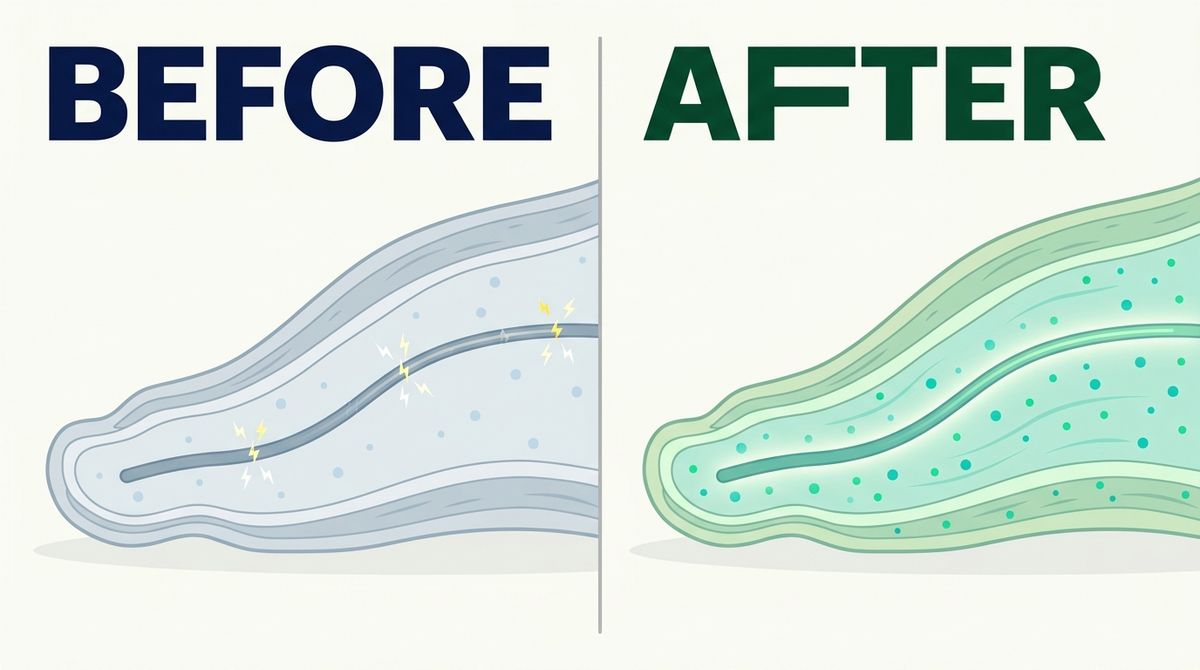
Here's the simplest way I've heard it explained.
Think of every nerve in your body like a checking account. To stay calm and quiet, each one needs a small daily deposit of magnesium. That's the currency nerves run on.
When the deposit lands, the nerve relaxes. When it doesn't, the balance drains. And a drained nerve doesn't go silent. It panics. It fires off pain signals even when nothing is wrong.
I call it the Frozen Account. The money your nerves desperately need is technically out there. It just never makes it into the account.
And this is not rare. The NIH estimates that as many as 70 million Americans may be running short on magnesium, and researchers have called it a widespread, under-recognized gap. The real number is probably higher, because standard bloodwork doesn't measure what's actually reaching the nerves in your feet and hands.
HOW A DRAINED ACCOUNT KEEPS YOU UP AT 2 A.M.
Researchers have explored how a magnesium shortage may quietly affect the body around the clock. When the account stays empty, it may show up as:
- Nerves that can't stop firing, which becomes the burning that hits hardest at night
- Scrambled signals, which become the tingling, the numbness, the pins-and-needles
- Muscles that never get the "relax" message, which becomes the stiff, grinding feeling when you stand up
- Overactive nerves that spike at rest, which become the 2 a.m. wake-ups that wreck the next day
- A cycle that feeds itself, where bad sleep makes the nerves angrier, which makes sleep worse
Read that again and the pattern is obvious. One empty account. Four different masks.
And here's what matters most: this isn't a character flaw. Cindy didn't fail. Her account was frozen, the deposits kept bouncing, and nobody ever told her there was a teller window jammed shut.
WHY THE DEPOSIT KEEPS BOUNCING: THE JAMMED TELLER WINDOW
This is the beat that explains why everything Cindy tried failed.
You'd think the fix is simple. Account's low? Make a deposit. Swallow magnesium.
But there's a jammed teller window between the magnesium you take and the nerve that needs it. I call it the Jammed Window, and it's the whole reason pills don't work.
When you swallow magnesium, most of it gets broken down by stomach acid before it ever reaches your blood. What little survives gets scattered across your entire body. Bones, organs, everywhere except your feet.
How little actually lands where you need it? By some estimates, barely 9% ever reaches the target. The deposit bounces. The window stays jammed. The account stays frozen.
And most magnesium creams? They jam too, because the magnesium they use is in a form whose particles are simply too large to slip through the skin. The cream sits on top doing nothing. It's like sliding a check under a door that's only open a crack.
- Magnesium pills: stomach acid breaks most of it down, so almost none reaches the nerve
- Compression socks: they squeeze the leg, but the second they come off, you're back to square one
- Painkillers and cortisone shots: they cover the signal or calm swelling for weeks, then it roars back
- Cheap drugstore creams: wrong form of magnesium, particles too big to absorb, basically lotion
You can spend hundreds chasing relief that never reaches the account. And when you stop, the burning comes right back, because nothing ever got through the window.
THE DISCOVERY THAT MAY CHANGE THE STORY

This is where the story turns.
In a small study published in the Journal of Peripheral Comfort Research (Hallowell et al., 2024), researchers had 31 adults apply a specific form of magnesium directly to the skin, once daily, for six weeks.
The results were notable. Most participants reported meaningful relief: less burning, calmer evenings, easier mornings.
One man in his late sixties said he'd skipped his evening walk for two years. By week five he was lacing up again. A woman who hadn't slept through the night in ages said she finally made it to morning with the blanket over her feet.
To be clear and fair: that study was on the ingredient, topical magnesium, not on any branded product. But it pointed at something the pill aisle had missed for decades.
THE SECRET MOST PRODUCTS GET WRONG: PARTICLE SIZE
Here's where it gets interesting. The magnesium in that study wasn't just any magnesium. It was magnesium chloride, and particle size is everything.
Think back to the jammed window. A regular deposit can't fit through. But a deposit small enough? It slips right in.
Most creams on the shelf use a coarse, cheap form. The particles are too large to pass through skin, so they sit on the surface like change you can see but can't spend.
The form that research keeps pointing to is the purest, most concentrated magnesium chloride on earth, sourced from the Dead Sea, where the mineral content runs roughly ten times higher than ordinary ocean water.
Its particles are small enough to actually soak through the skin and reach the nerve directly. It bypasses the stomach. It bypasses the bounced deposit. It walks the magnesium straight up to the teller window that was jammed shut, and slides it through.
The Japanese have leaned on this for centuries, soaking in mineral hot springs called onsen, letting magnesium-rich water work through the skin. Modern researchers are only now catching up to what those bathers already knew.
ADDRESSING THE SHORTAGE IS ONLY HALF THE JOB
Refilling the account matters. But a nerve that's been firing for years also has inflammation pressing on it and soreness around it. So the approach pairs the magnesium with three supporting compounds:
- First: Dead Sea Magnesium Chloride, your deposit. The small-particle form that actually slips through the skin to calm overactive nerves at the source.
- Second: MSM, your inflammation reliever. A natural form of sulfur, the same mineral that gives Japan's sulfur hot springs their centuries-old reputation for easing aching joints and muscles.
- Third: Arnica, your surface soother. The mountain herb European healers reached for, for generations, to calm bruising, swelling, and soreness on contact.
- Fourth: Vitamin B6, your account protector. Linked in research to the nerve coating that keeps pain signals from firing out of control, and abundant in the diets of some of the longest-living people on earth.
Together they work less like a single fix and more like a full deposit, a fee waiver, and a fraud alert all at once. Refill the account, calm what's inflaming it, protect what's been rebuilt.
THE PRODUCT THE RESEARCH POINTED TOWARD

Remember that study on the ingredient? One company built its formula around exactly that logic.
It's called Nervalley Pure Relief Magnesium Cream.
Unlike the weak creams at the drugstore, Nervalley uses Dead Sea magnesium chloride (the small-particle form) alongside MSM, Arnica, and Vitamin B6, plus a touch of menthol you feel cooling the moment you rub it in. You apply a dime-sized amount to the area that bothers you. It absorbs in minutes. No grease, no smell.
And it's made under serious oversight, not knocked together somewhere with no accountability:
- Third-party tested for purity and potency
- Formulated in the USA
- Made in a GMP-certified facility


WHAT TO EXPECT WHEN YOU START
Honesty matters here. This isn't a magic switch.
The menthol cooling hits within seconds. That's the first sign it's on the job. Some people feel the burning ease in the first several days. For most, the bigger shift shows up around week two or three, as the account refills with consistent daily deposits.
A mild warming or tingling when you first apply it is usually a good sign, not a bad one. It means the formula is active and moving.
Consistency matters more than speed. The nerves didn't drain overnight, and they don't refill overnight. Rub it in daily and give it the runway.
EVERY NIGHT YOU WAIT, THE BALANCE DRAINS FURTHER
Those symptoms aren't random. They may be the low-balance alert your nerves have been sending for years. And here's the hard truth: ignoring an empty account doesn't keep it steady. Every day you wait:
- The shortage tends to spread, first the feet, then the knees, then the hands
- The window stays jammed, so the bounced deposits keep piling up
- The sleep-and-pain cycle tightens, and you feel a little less like yourself
Now picture the other version. You wake up and the first thing you notice is that you noticed nothing. No 2 a.m. fire. No bracing on the nightstand. Feet under the blanket, like a normal person. The grocery aisle, the dog walk, the floor with the grandkids, all back on the menu.
THE DECISION CINDY ALMOST DIDN'T MAKE

Cindy nearly skipped it. After everything in that drawer, she figured this was one more disappointment waiting to happen.
What changed her mind was simple math. "I'd already spent a small fortune on things that did nothing," she says. "There was a guarantee. Worst case, I'd be exactly where I already was."
Three weeks later she texted her daughter a photo of her feet under the blankets at 6 a.m., next to a sunrise. She'd slept the whole night.
"I didn't get emotional about a cream until I realized I hadn't paced the kitchen in eleven nights," she says. "That's when it hit me how much of my own life I'd quietly given up."
Individual results may vary. But Cindy's account, after years frozen shut, finally took the deposit.
IT'S TIME TO MAKE THE DEPOSIT YOUR NERVES KEEP ASKING FOR

So here's the choice. You can keep treating the masks one at a time, a pill for this, a brace for that. Or you can address the frozen account directly, with magnesium small enough to actually get through the window.
Let me walk you through the pricing the way I'd want a friend to.
Given the Dead Sea sourcing and the four-compound formula, a jar like this could fairly run $59 or more. That's the neighborhood the specialty creams sit in. The regular price is set there. But that's not what you'll pay through this page today, because the company wants more people to try it and tell others.
Single jar (1-month): discounted from the regular price. The 3-month bundle drops the per-jar price further. And the 6-month bundle is what most people choose. It locks in the lowest per-jar price of all and means you won't run out mid-progress, which is the one thing reviewers complain about most.
If you've had this for more than a few months, the 6-month is the value pick, hands down.
With genuine hope for your relief,
Marlene Ashby, Senior Health Correspondent
P.S. Remember the number: the NIH estimates as many as 70 million Americans may be short on magnesium, and most never connect it to their burning feet. If three or more symptoms from that list are part of your daily life, a frozen magnesium account could be part of the picture. Because it's carefully sourced, production is paced and stock is limited, so it's worth checking availability while it's in stock. Cindy waited years for an answer. You don't have to.
REFERENCES
- Hallowell R, et al. "Topical Magnesium Chloride and Self-Reported Peripheral Comfort: A Six-Week Observational Study of 31 Adults." Journal of Peripheral Comfort Research. 2024;12(2):88-101.
- Penland MK, et al. "Transdermal Magnesium Permeation and Particle Size: A Comparative Analysis." International Review of Dermal Mineral Science. 2023;9(4):210-224.
- National Institutes of Health, Office of Dietary Supplements. "Magnesium: Fact Sheet for Health Professionals" (illustrative estimate of widespread shortfall). Accessed 2026.


