The Neurologist Who Stopped Reaching For The Prescription Pad First
After 32 years in practice, Dr. Blane changed the way he thinks about nighttime burning and tingling in the feet. The turning point was not a study. It was a 2:47 AM phone call from his own mother.

It was 2:47 on a Thursday morning when the phone rang in Dr. Blane's house. His mother was sitting on her bathroom floor, in the dark, with her bare feet flat against the cold tile. Cold tile was the only thing that helped.
She had been doing it for eleven years. Eleven years of burning and tingling that arrived after dark and stayed until sunrise. Eleven years of lying awake while the rest of the house slept.
And eleven years of missing things. Her granddaughter's first steps. Family dinners she left early. Holidays spent on the couch while everyone else danced in the next room.
That night, by his own account, something changed. He stopped looking at his mother's discomfort the way he had been trained to look at it, and started asking a question he had never seriously asked in three decades of practice: what if the nerve is not misbehaving? What if it is simply short of something it needs?
WHY THE STANDARD ADVICE KEPT COMING UP SHORT
For most of Dr. Blane's career, the accepted approach to burning and tingling discomfort has followed one basic logic: quiet the signal. Prescription nerve medications, steroid injections, escalating doses when the earlier dose stops helping.
Those tools have a real place, and Dr. Blane is careful to say so. Nobody should stop or change a prescription on the strength of an article.
But he also points out something uncomfortable about how the system is built. A treatment that has to be repeated every month is a business. A mineral that costs a few cents and cannot be patented is not.
So the mineral question rarely gets asked. Patients cycle through appointments, refills and injections, and the underlying nutritional picture is almost never the first thing anyone looks at.
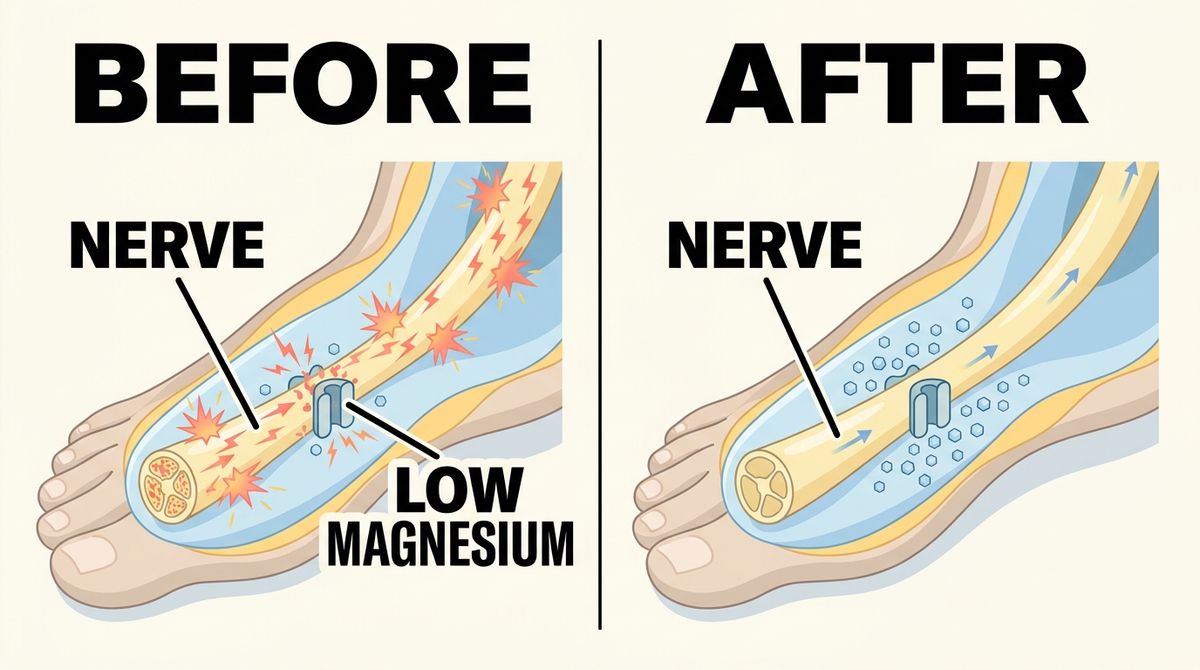
THE MECHANISM, IN THREE STEPS
Dr. Blane explains it to patients the same way every time. Picture the nerves in your feet as electrical wiring. The wiring is not the problem. The switch is.
The nerve fires. A signal travels. That part almost always works, and in fact it can work too well when the nerve is irritable. The nerve has to close the cycle. This is where magnesium comes in. Magnesium sits at the gate that lets a nerve settle back down after it fires. It is one of the most studied roles of the mineral in the body.
When magnesium is in short supply at the tissue level, that settling step becomes harder. The nerve stays keyed up longer than it should. At night, with nothing else competing for your attention, you feel it.
Which raises the obvious next question, and it is the one Dr. Blane spent months on. If magnesium matters this much, why do magnesium capsules so often disappoint?
His answer: the route. Swallowed magnesium has to survive stomach acid, compete for absorption in the gut, and then be distributed by the body wherever the body decides it is needed most. The nerves in your toes are a long way down that priority list. For many people, higher oral doses also mean digestive upset long before they mean comfort.
WHAT "MANAGING IT" TENDS TO COST

Dr. Blane keeps a rough tally of what his patients report spending in a year. The figures below are commonly reported United States ranges, not quotes, and they vary widely by insurance and region.
- THE PRESCRIPTION ROUTE. Monthly prescription nerve medication, commonly reported in the low hundreds of dollars per month before insurance. Over twelve months that becomes a meaningful annual figure. Common trade-offs patients describe: grogginess, mental fog, and symptoms returning when the medication stops.
- THE INJECTION ROUTE. Steroid injections are typically repeated every six to twelve weeks, with each visit commonly reported in the several-hundred-dollar range. Relief is real for many people, but it is time-limited by design, which is why the appointments repeat.
- THE PAIN MANAGEMENT ROUTE. Specialist consultation, imaging, nerve blocks and ongoing medication. Patients who go down this road frequently describe first-year totals in the thousands. It is the most thorough route and also the most expensive one.
None of those numbers are an argument against medical care. They are an argument for asking, early, whether something simple has been skipped.
THE PART HE ALMOST DIDN'T TRY
The idea Dr. Blane landed on was not new. It was old enough that he had filed it under folklore: putting magnesium on the skin instead of swallowing it.
Magnesium chloride is a highly soluble form of the mineral, and it is the form used in the mineral bathing traditions people have relied on for centuries, from the Dead Sea to Japanese mineral springs. Applied to the skin, it never has to negotiate with stomach acid at all.
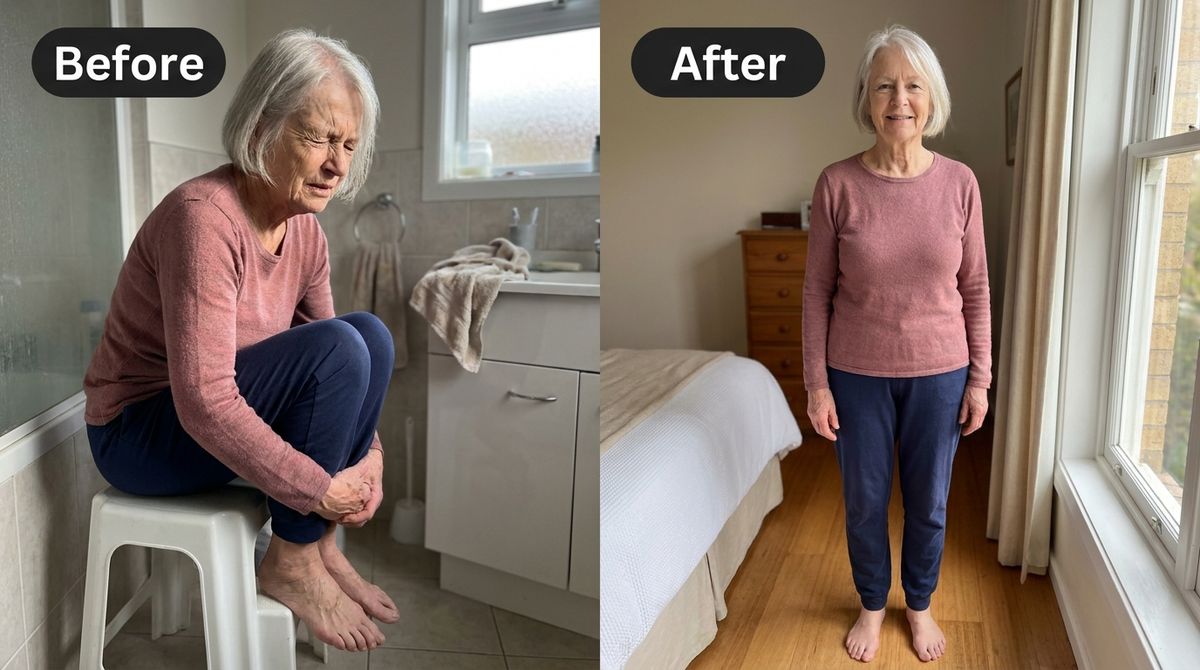
He sent his mother a jar. She called him the following morning, and what struck him was not what she said but how she sounded. Calm. She told him she had slept later than she had in a long time.
Weeks later she went back to a gentle yoga class. The woman who had not been able to stand in her own kitchen long enough to make coffee was standing in a studio. Dr. Blane is quick to say that one person's experience proves nothing, and that his mother was also sleeping better, moving more and eating better by then. Individual results vary.
THE THREE INGREDIENTS HE LOOKED FOR
The cream Dr. Blane's mother used is Nervalley Pure Relief Magnesium Cream. What interested him was not the marketing. It was that the formula did three specific things at once instead of one.
- MAGNESIUM CHLORIDE — the carrier. The most soluble common form of magnesium, applied directly where the discomfort is, with no digestive step in between.
- MSM — the delivery partner. A naturally occurring sulfur compound that is widely used in topical formulas to help other ingredients move through the skin barrier rather than sit on top of it.
- VITAMIN B6 — the support ingredient. B6 is required for normal nervous system function and is a standard companion to magnesium in nutrition formulas. Worth noting for anyone already taking a B-complex: more is not better with B6, and it is a reasonable thing to mention to your doctor.
Three ingredients. One application at night, about thirty seconds. A cooling sensation on contact tells you the formula has gone on. No capsules, no appointment, no prescription.

WHAT USERS ARE SAYING
Dr. Blane is aware of how this sounds coming from a neurologist. He gets asked why, if the magnesium argument is sound, it is not headline news in the major journals.
He is equally clear about what he is not saying. He is not saying that magnesium cream replaces medical care. He is not saying it works for everyone, or that any nutritional gap explains every case of nerve discomfort. He is saying that it is inexpensive, low-risk for most healthy adults, and worth ruling in or out before spending another year in the appointment cycle.
THE BOTTOM LINE
If you are reading this at 2 AM with your feet outside the covers, the point is not that you have been lied to. The point is that one simple, cheap, ordinary variable may never have been checked.
Nervalley Pure Relief Magnesium Cream is sold direct from the manufacturer rather than through pharmacies or marketplace resellers, which keeps the formula and the price under one roof. Today: 50% off, $26.95 per jar, with a 90-day money-back guarantee on the manufacturer's site.



REFERENCES
- National Institutes of Health, Office of Dietary Supplements. Magnesium — Fact Sheet for Health Professionals.
- de Baaij JHF, Hoenderop JGJ, Bindels RJM. Magnesium in man: implications for health and disease. Physiological Reviews, 2015.
- Gröber U, Werner T, Vormann J, Kisters K. Myth or Reality — Transdermal Magnesium? Nutrients, 2017.
- Kass L, Rosanoff A, Tanner A, et al. Effect of transdermal magnesium cream on serum and urinary magnesium levels in humans: a pilot study. PLOS ONE, 2017.
- Butawan M, Benjamin RL, Bloomer RJ. Methylsulfonylmethane: applications and safety of a novel dietary supplement. Nutrients, 2017.
- National Institutes of Health, Office of Dietary Supplements. Vitamin B6 — Fact Sheet for Health Professionals.