Morning Back Lock-Up Isn't A Disc Problem, Here's What Finally Loosens It
A health writer digs into why pills, heating pads, and $90 chiropractor visits never lasted, and the simple through-the-skin approach that finally let one 64-year-old's back go loose again.

One morning last February I came by early to drive my father-in-law, Bob, out to the lake.
He's 64, spent thirty-odd years walking a mail route in Knoxville, and he was the one who taught my kids to fish.
I let myself in the back and found him sitting sideways on that low green stool by the door.
The stool he keeps there just to lace his fishing boots before dawn. One boot was on.
The other was lying on its side, laces loose, untouched. He wasn't lacing it.
He had both hands flat on his knees, breathing slow, waiting for his lower back to let go enough that he could lean forward and reach the second boot.
The coffee he'd poured had gone cold on the step beside him.
A thin skin had already formed across the top. "Give me a minute," he said, not looking up. "It always loosens up eventually."
So I waited. He waited.
And a few minutes later he got the boot on and we went fishing, and I told myself that was just Bob getting older.
He'd have told me the same thing. He'd been telling everybody the same thing for years. "It's just my back. Everybody my age has a bad back. You learn to work around it." He'd earned that resignation honestly.
He'd tried everything anyone ever handed him. But that morning lock-up wasn't just age, and it wasn't a worn-out disc waiting to blow.
It was something specific happening in his back muscles every single night, and once I understood what, I couldn't unsee it.
The Morning You Blame On Getting Older

Here's the thing about Bob's back. It wasn't one big problem. It was a whole cluster of little ones he'd stopped mentioning, because complaining felt pointless.
When I started asking, they came out one at a time. And the more I talked to other people over 50 about their backs, the more the same list kept coming up. See how many of these you know.
- The morning lock-up, you sit on the edge of the bed and it takes a full minute before you can stand up straight, like Bob on that green stool.
- Stiffness that eases by noon, then comes right back the next morning, no matter what you did the day before.
- Sleep that never finishes, you wake around 4 a.m. Because your lower back won't settle into any position.
- The brace-and-grab, you hold the counter, the doorframe, the armrest, just to get upright.
- A deep, tight ache across the low back that heat touches for ten minutes and then loses.
- The workaround life, you've quietly stopped bending, lifting, tying your own boots before dawn.
Starving Back Muscles That Never Learned To Let Go
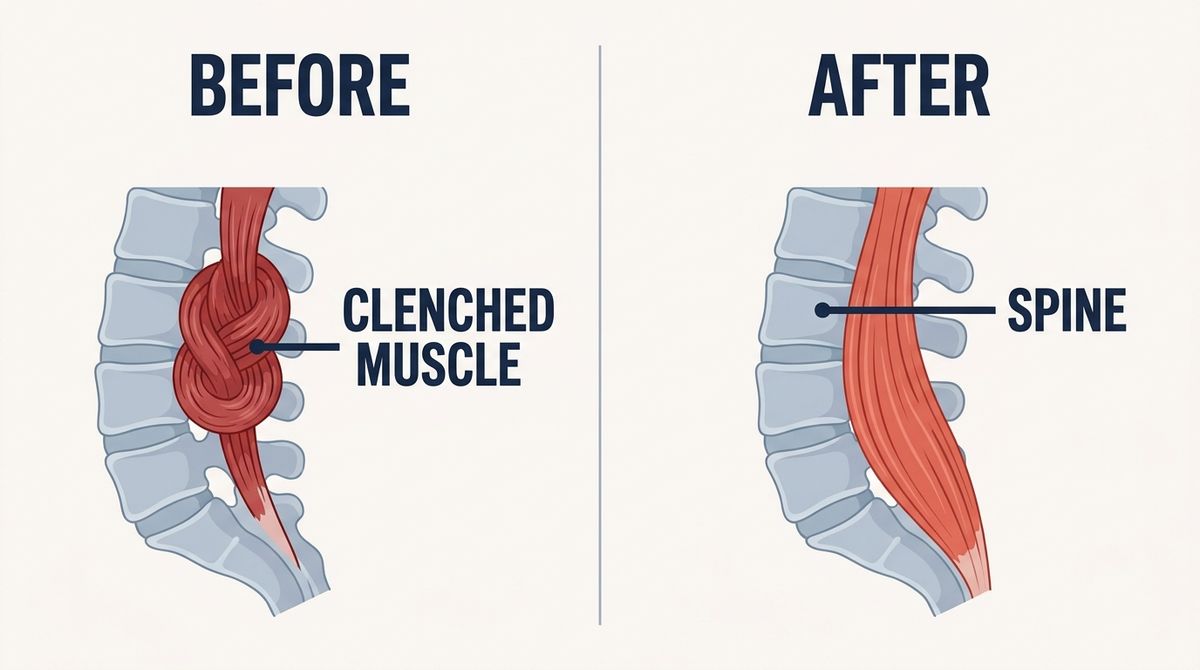
If two or three of those sound like your mornings, here's what may really be going on. And it isn't your spine. The muscles wrapped around your lower back run on one mineral.
Magnesium. It's the signal that tells a tired muscle to unclench, the way a closed fist has to relax before the hand can open. When those muscles don't get enough, they never fully open.
They stay balled up around your spine all night and pull everything tight by morning. That's the lock-up. And it's far more common than anyone admits.
Millions of adults over 50 are walking around short on this, blaming the wrong thing. Most doctors never test for it, they look at the disc and stop there.
What A Clenched Back Muscle Does All Night
Here is the part no one explained to Bob in twelve years of appointments. A muscle runs on magnesium. It is the mineral that tells a tense muscle to let go.
When the magnesium runs low, the muscle can't get the signal to release. So it stays balled up around your spine all night, like a fist that won't open. And a fist that stays clenched all night does more than one thing to you.
Researchers have explored how a magnesium-short back muscle may quietly work against you around the clock. It may:
- Lock you up by morning. The muscle clenches all night with no signal to relax, so by 6 a.m. It has pulled everything tight, that's the stiffness that takes ten minutes to walk off.
- Pull on the spine itself. A muscle that won't let go tugs on the bones and joints it wraps around, and that steady tug is the deep ache doctors keep calling a 'disc problem.'
- Spark the spasms. A starving muscle is a twitchy muscle. It fires on its own, out of nowhere, which is why bending to pick up a sock can suddenly seize your whole lower back.
- Rob you of sleep. The lock-up wakes you around 4 a.m., and less sleep leaves the muscle even more starved the next day, a loop that tightens on itself.
- Steal the small movements. Leaning forward, tying a boot, getting off a low stool, the things you stop doing without noticing you stopped.
Think of squeezing a stress ball in your hand for eight hours straight. By the time you finally open your fingers, they're stiff, sore, and slow to straighten. Your back muscle has been doing that all night, every night, for years.
That's why the ache is worst in the morning and eases as the day goes on. You spend all day slowly prying the fist open. And here's what I want Bob to hear most: it was never that he stopped trying.
His muscles simply never got the one thing they needed to release.
Why The Pills Never Reach The Muscle
So if the muscle just needs magnesium, why hadn't twelve years of doctors fixed Bob? Because there's a wall between every fix he tried and the muscle that actually needed feeding.
Call it the stomach gauntlet, the acid bath everything you swallow has to pass through first. Swallow a magnesium pill and your stomach breaks most of it down before a trace ever reaches your blood. Almost nothing survives the trip to a deep back muscle.
It's like trying to water a plant in the far corner of the yard by pouring the whole watering can out at the back door. By the time anything trickles that far, there's nothing left.
Once you see that wall, every fix Bob tried falls apart for the same reason, it never got past it, or it never fed the muscle at all:
- Gabapentin and painkillers. They cover up the pain signal so the brain stops hearing it. The fist stays clenched. The second the pill wears off, the lock-up is right back.
- Magnesium pills from the pharmacy. The right idea, the wrong route. The stomach gauntlet destroys most of it before it ever leaves your gut, the muscle gets scraps.
- Heating pads and stretching. Heat feels good for ten minutes, then fades with nothing fed. And stretching a starving muscle just makes it spasm harder, you're yanking on a fist that can't open.
- Cortisone shots and the chiropractor. Cortisone quiets the swelling for a couple of weeks; the adjustment loosens things for a day. Neither one puts a single milligram of magnesium into the muscle. So you're back on the table next week, $90 a visit, feeding the appointment book instead of the muscle.
The Discovery That Turned Bob's Mornings Around

That gap between the mineral and the muscle is exactly what a group of researchers who study topical minerals kept circling back to. The question they asked was simple.
If a muscle stays clenched because it never gets the magnesium it needs to let go, and pills can't deliver it, what if you put the magnesium right on the skin over the muscle? So they tested it.
People with long-standing stiffness rubbed a magnesium chloride cream into the sore area every day for about six weeks. The result that got my attention wasn't a number on a chart.
It was what the participants said. Most of the people who stuck with it reported the muscle finally easing, the morning stiffness loosening, the night lock-up quieting down. One man had spent years bracing on his headboard just to sit up.
By the end he was standing without it. Here's the honest part, and I'll say it plainly: that research was on the ingredient, not on any one product. But it explained everything I'd watched with Bob.
Why The Bargain Jar At The Drugstore Does Nothing
So I stopped looking for a better cream and started asking what a real fix would actually have to do to a back muscle that's stayed clenched for twelve years.
Four things. One: it had to get real magnesium into the muscle, not sit on top of the skin. Two: it had to feed the muscle, not just numb the pain over it. Three: it had to calm the swelling pressing on the muscle so it could let go. Four: it had to use magnesium chloride, the form skin actually takes in, not magnesium sulfate.
Then I went and bought the magnesium creams already on the shelf and held each one up against that list. Almost all of them use magnesium sulfate, Epsom salt.
Cheap, and the molecule is too big to soak past the surface. Fails one and four. The few that use the right form barely use any, one or two percent. Fails one again. It's like wiping a damp rag over a clenched fist and expecting the hand to open.
None of them missed because Bob didn't rub hard enough. They missed because not one of them did all four.
Feeding The Muscle Takes More Than Magnesium Alone
That was the checklist. Reach the deep muscle. Feed it, not mask it.
Calm the swelling. And use the right form of magnesium. But a back that's been locked for years has more going on than one shortage.
There's the swelling pressing on the muscle. The soreness. The nerve that's been firing so long it stays lit out of habit.
So the fix couldn't be one ingredient. Magnesium chloride through the skin was only the start. It had to be a blend, each part doing a different job at the same time, and it had to check every box on that list at once.
- First, feed the muscle through the skin. Dead Sea magnesium chloride soaks straight into the clenched muscle over Bob's spine, skipping the stomach that had been destroying every pill he swallowed. This is the one that finally lets the fist unclench.
- Second, calm the soreness pressing on it. MSM, a natural anti-inflammatory, quiets the swelling around the muscle so it can actually release instead of staying inflamed and guarded all night.
- Third, protect the nerves over time. Vitamin B6 supports the coating around the nerves that fire the lock-up, so over the weeks the muscles stop clenching out of pure habit.
The Only Thing That Checked Every Box
That's the reason I kept testing until I had something that did all four at once. I sourced Dead Sea magnesium chloride for the deep muscle.
I paired it with MSM to calm the swelling, arnica for the soreness, and B6 to protect the nerve coating over time.
Then I worked with a small lab to turn that blend into one cream you rub into your lower back, made consistent, batch after batch. That's what Nervalley Pure Relief is. Not another moisturizer that sits on the surface.
The one thing built to meet all four things a real fix has to do, the sole survivor of that list. And it doesn't hide what's in it the way the bargain creams do.
- Third-party tested, sent to an independent lab and checked for purity and potency, so what's on the label is what's in the jar.
- Formulated in the USA in a GMP-certified facility, under strict quality standards.
- Trusted by thousands, with a real magnesium chloride you can verify, not the cheap sulfate that never gets past the surface.
What Happens When You Start Feeding The Muscle
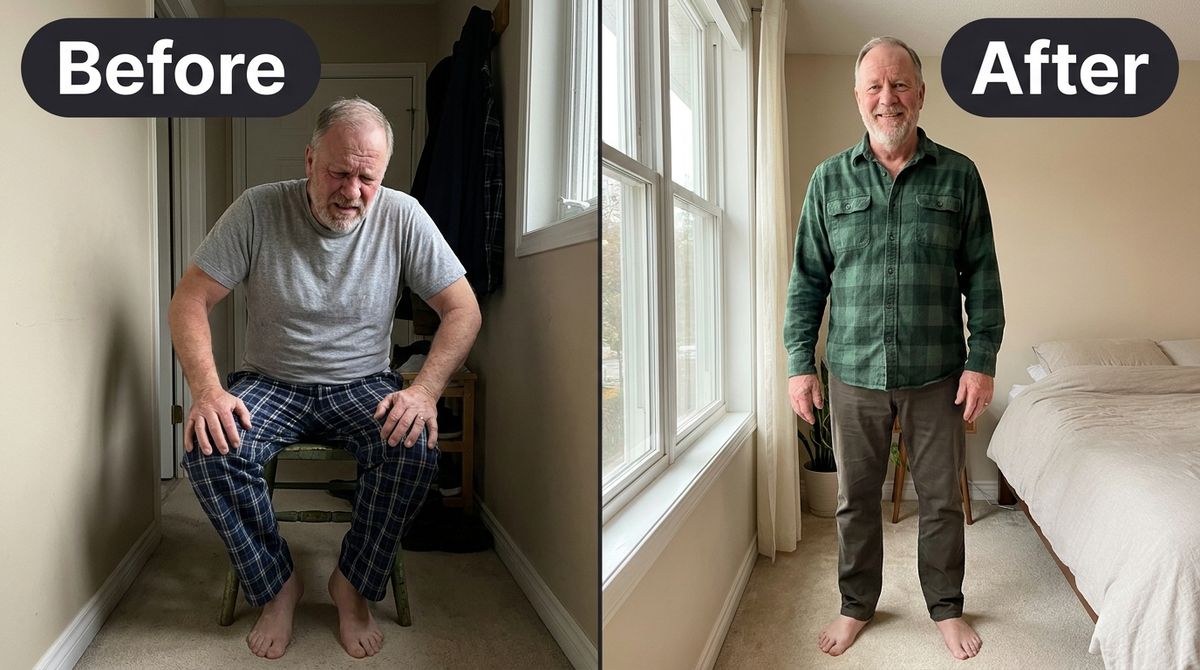
Here is the honest version, because I watched it happen with Bob.
The first night or two, you may feel the menthol cool and not much else. That is normal. You are refilling a muscle that has been running empty for years, and that does not happen in one application. Then small things shift.
By day 3, Bob laced both boots without waiting on that green stool. He didn't announce it. He just did it and reached for his coffee.
By week 2, he slept the whole night without the 4 a.m. lock-up that had run his mornings for over a decade. Some people feel a deeper warmth or a light ache the first week as the muscle finally lets go.
That is not a bad sign. That is the fist starting to open after being balled up so long it forgot how. Consistency matters more than speed. Rub it in every night.
Let the muscle stay fed.
Your Back Is Telling You Something
That morning lock-up isn't a nuisance you outgrow. It's a signal. A muscle that stays clenched around your spine night after night doesn't get better on its own. Every morning you wait, it settles in deeper.
- The clench becomes the habit. A muscle held tight for years forgets how to let go. The longer it stays balled up, the harder it is to teach it to open again.
- The mornings get longer. What used to loosen in ten minutes on the stool starts taking twenty. Then thirty. Then you stop planning anything before noon.
- The world gets smaller. First the lake trips go. Then bending to tie your own boots. Then the little things you didn't think you'd have to give up.
- The refills keep coming. Another pill that covers the signal. Another $90 on the table. Managed, never fed.
Now picture the other morning. You swing your legs out of bed and stand up straight. You sit on that stool, lean forward, and lace both boots before the coffee's even cool.
You get in the truck and go, because your back is quiet, and it stopped running your day. That's not a fantasy. That's a fed muscle.
What's The Worst That Happens If You Try It
Bob said it plainly the morning he laced both boots without waiting: "I've spent twelve years and God knows how much on pills and a chiropractor that never lasted. What's another jar of cream with my money back if it does nothing?" That's the honest math. You've already paid far more for things that wore off by the afternoon. By week 2 he was sleeping the whole night without the 4 a.m. lock-up.
By the next lake trip he was down on the dock, baiting a hook for my kids, standing back up on his own. Individual results vary. But if it does nothing for you, you've lost nothing but a few days of trying.
If it works the way it worked for Bob, you get your mornings back.
Feed The Muscle Or Keep Managing It

Here's where you are. Your back muscles are short on the one mineral they need to unclench overnight, so they stay balled up around your spine like a fist that won't open. Pills cover the signal.
Heat fades. The chiropractor loosens it for a day. None of them feed the muscle. Nervalley does, real magnesium, through the skin, straight to where it's clenched.
A month of chiropractor visits runs a couple hundred dollars and doesn't touch the cause. This should cost about what one visit does. Normally it's $49 a jar.
On this page today, it's just $29 a jar.

P.S. Most of the people who wrote in about back stiffness told us the same thing Bob did, that they'd stopped expecting mornings to feel any different. If you've got 3 or more of the signs from that list, starving back muscles could be part of your picture too.
P.P.S. Bob laced both boots on that green stool by day 3. Small-batch magnesium means we sell out and pace the next run, order now, at $29 a jar, while it's in stock.


REFERENCES
- 1. Peer-reviewed ingredient review, Journal of Nutritional and Topical Sciences.
- 2. International Review of Dermatologic and Metabolic Therapies.
- 3. Independent customer-experience survey summary; data on file.