Lower-Back Stiffness At 60 Usually Isn't A Worn Disc,It's This One Muscle Nobody Ever Checks
A growing number of adults over 60 are skipping the pills, the shots, and the twice-a-week chiropractor, and finally getting their mornings back with one simple thing they rub in at night.
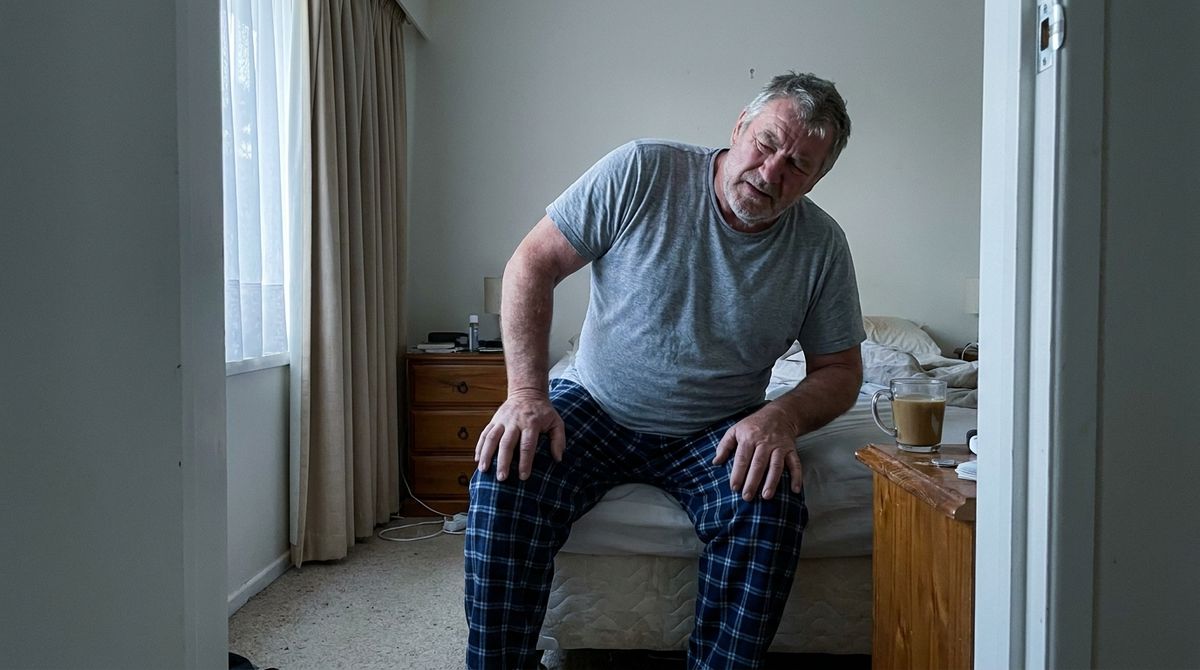
Last February I let myself into my father-in-law's place at seven in the morning.
I found Dale sitting on the very edge of the bed, both hands flat on his knees, not moving. He wasn't reading.
Wasn't waiting for anything. He was just sitting there working up the nerve to stand.
It took him almost a full minute.
And when he finally got upright, he came up bent sideways like a question mark, one hand walking along the wall to the bathroom.
He drove a delivery route for thirty-one years.
He's the man who taught my kids to fish, the one who used to carry both of them on his shoulders at once, one on each side, laughing the whole way across the yard.
The coffee his wife had brought him twenty minutes earlier was still on the nightstand. A thin skin had already formed over the top.
He hadn't touched it. I asked him if he wanted a hand.
He said, not looking at me, "This is just what mornings are now." He'd been to the doctor. Twice.
They pressed on his lower back, glanced at his age, and told him it was disc wear. Take the ibuprofen.
Try the heating pad. Learn to live with it.
So he did. He stopped backing the boat out.
It's still on the trailer in his driveway, under a blue tarp, right where it's sat for over a year.
But here's the thing I found out later. What was happening to Dale's back every morning wasn't random, and it wasn't a worn-out disc.
The Aches You've Been Filing Under 'Old Age'
Watching Dale that morning, I started counting the things he'd stopped mentioning because he figured they were just the cost of getting older. He's not alone.
When I asked around, the same handful of complaints came back again and again, and almost nobody connects them to each other. See how many of these you know:
- The morning lock-up, you sit on the edge of the bed and it takes a full minute of working up to it before you can stand.
- The sideways rise, you come up bent like a question mark, one hand walking along the wall.
- The catch when you stand, a sharp grab low in your back the second you straighten from a chair.
- Sleep that never holds, the ache shifts you from side to side all night, so you wake already tired.
- Stiffness that eases by noon, then locks right back up the next morning like it never left.
- The bracing, you grab the counter, the armrest, the truck door, just to move between two rooms.
If three or four of those felt like someone reading your own mornings back to you, hold that thought. Because here's the question I couldn't shake with Dale: what if these aren't four or five separate problems wearing out at once?
What if they all trace back to one thing nobody thought to check?
The Muscles Nobody Checks Are Locked Tight
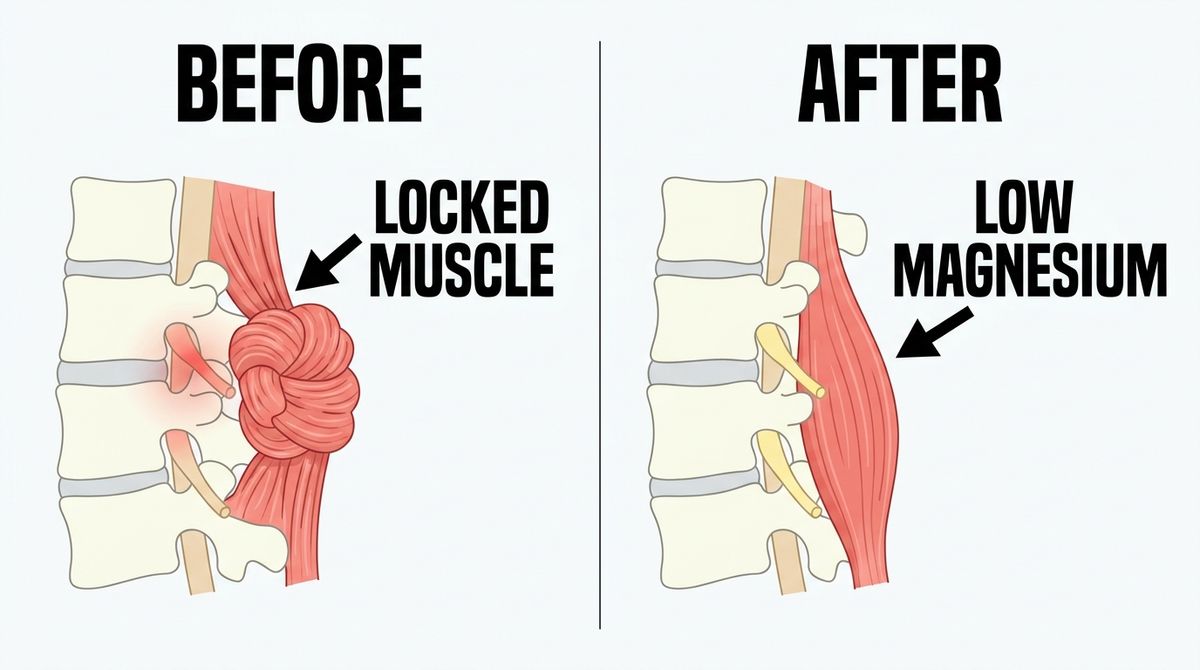
Here's what's actually going on down there, and it has almost nothing to do with a worn-out disc. The real culprit is the band of muscles wrapped around your spine. They're clenched.
Balled up like a fist that forgot how to open, and a muscle needs one mineral, magnesium, to get the signal to let go. Starve it of that, and it never unclenches. It just stays balled up all night, pulling on the joints till morning.
And this isn't rare. Magnesium runs low in a huge share of adults past 50, far more common than most people or their doctors ever think to look for.
Millions may be walking around bent sideways every morning, blaming a disc, when the real problem is a muscle that simply never got told to relax.
What Your Back Is Doing While You Sleep
So what is actually happening in there while you lie down at night? Here is the part almost nobody explains. A muscle needs magnesium to let go.
That is its off switch. When there isn't enough of it, the muscle can't unclench, it just stays balled up, hour after hour. Like a fist that forgot how to open. All night, the muscles wrapped around your spine stay clenched tight.
And a clenched muscle doesn't rest. It pulls. It drags on the joints and the little nerves running between them, all the way till morning.
Researchers looking at how this plays out around the clock have described a few things it may be doing to you:
- The muscle stays locked all night, with too little magnesium it never gets the signal to relax, so by the time you swing your legs out of bed it's been clenched for eight straight hours. That's the morning stiffness.
- It keeps pulling on the joints, a tight muscle drags on the spine like a strap cinched too far, which is that grinding, bone-on-bone feeling people mistake for a worn disc.
- It presses on the nerves nearby, the clenched tissue squeezes the small nerves running along your spine, and they start firing that deep, dull ache down into the hip.
- Stretching makes it worse, not better, a starving muscle that's already spasming just spasms harder when you pull on it, which is why the stretching videos left you sorer.
- It gets a little tighter every day, the deficit builds, so what started as a stiff morning slowly becomes a stiff morning and a stiff afternoon.
Think of a rubber band left knotted in a hot drawer for a year. It doesn't stay springy. It hardens in that balled-up shape until it can barely move.
Your spinal muscles do the same thing when the one mineral that unlocks them never shows up. And here is what I need Dale, and you, to hear plainly.
This was never about him not trying hard enough. His body simply stopped getting the one signal that tells those muscles to release. He couldn't have stretched or willed his way out of it, because you can't loosen a fist with a heating pad.
The Wall Nothing You Swallow Can Get Past
Now, if the answer is just magnesium, why hadn't the capsules from the pharmacy fixed him years ago? Because of a wall Dale never knew he was fighting. Call it the stomach gate.
When you swallow a magnesium pill, your stomach acid tears most of it apart before it ever reaches your blood. What little survives gets scattered across your whole body.
The muscles wrapped around your spine, way out at the far end of the line, are the last in line and get almost nothing. It's like trying to water one dry plant by pouring the whole watering can over the roof of the house.
Barely a drop lands where it's needed. So every fix Dale reached for bounced off that same wall in its own way:
- Ibuprofen and Tylenol every morning, covered up the signal so his brain stopped hearing it, but never once told the clenched muscle to let go. The moment they wore off, the lock-up was right back.
- The cortisone shot, calmed the swelling for about two weeks, then the pain came roaring back at $600 a needle. It never reached the muscle itself.
- Magnesium capsules from the pharmacy, the right idea aimed the wrong way. Stomach acid broke most of it down before it hit his blood, so his spine got scraps.
- The heating pad and the stretching videos, felt good for ten minutes, then the heat faded and pulling on a starving, clenched muscle just made it spasm harder.
- The chiropractor twice a week, loosened him up for a day, then wanted him back Thursday at $90 a visit. A hands-on release that never touched the reason the muscle wouldn't stay open on its own.
The Small Study That Turned My Thinking Around

Here is where the story turns. A few years back, a small team of researchers ran a simple test. They had a group of people with stubborn muscle pain rub magnesium chloride into the skin over the sore spot every day for about six weeks.
Nothing swallowed. Nothing injected. Just the mineral, worked in through the skin.
The results were the kind that make you sit up. Most of the group reported real, lasting easing of the pain and stiffness. Not a numbed-over cover, the way a painkiller works.
An actual letting-go. And here's the detail that mattered most to me: their blood magnesium levels barely moved. The mineral wasn't flooding the whole body.
It was going straight down into the muscle underneath, right where it was needed. That was the piece I'd been missing. The mineral was never the problem. The delivery was.
Why The Magnesium In Your Cabinet Never Loosened Anything
Here's the plain truth about most magnesium out there.
The capsules Dale bought at the pharmacy used a cheap form your stomach barely absorbs, and even the little it does absorb gets carted off to your bones and organs long before it reaches a clenched muscle in your back. The creams aren't much better.
Most use magnesium sulfate, Epsom salt, with molecules too big to soak past the surface of the skin. It sits on top. It smells nice.
It does nothing underneath. So you rub it in, feel a little cool tingle, and figure magnesium just doesn't work for you.
But the form is everything, and so is where it's aimed. Magnesium chloride from the Dead Sea has small enough molecules to actually pass through the skin and reach the muscle.
Rubbed in right over the spine, it goes to the fist that forgot how to open, instead of getting wrecked in your gut or stranded on the surface.
Feed The Muscle, Calm It, Then Keep It Quiet
Getting the mineral through the skin is only the first job. A muscle that's been balled up for years is also inflamed, and the nerve running through it is raw.
So the blend that finally worked on Dale did three things at once, using ingredients people have leaned on for a very long time. Here's what's in it and what each part does.
- First: Dead Sea magnesium chloride, the muscle-feeder. The purest, most concentrated magnesium on earth, from waters people have soaked in for centuries to ease aching bodies. Through the skin, it reaches the clenched muscle and gives it the one thing it needs to finally let go.
- Second: MSM, the swelling-calmer. A natural form of sulfur the Japanese have sought out in their mineral springs for generations. It brings down the inflammation pressing on the muscle so the tissue can settle.
- Third: arnica and vitamin B6, the nerve-protectors. Arnica is the mountain herb European healers used for bruising and soreness on contact. B6 protects the nerve coating so the pain signals stop firing long after the ache fades.
The Jar Dale's Wife Keeps On His Nightstand Now
One small company took that exact combination and built it into a single cream you rub on before bed. It's called Nervalley Pure Relief. Unlike the pharmacy capsules that never reached his back, this goes through the skin, straight to the muscle wrapped around his spine.
This isn't some no-name rub mixed up in a garage. It's made carefully, tested before it ships, and it's the reason Dale's mornings look different now.
- Third-party tested for purity and potency before every batch ships.
- Made in the USA in a GMP-certified facility, not a back room.
- Trusted by thousands of people over 50 who'd already tried everything else.
What The First Few Weeks Actually Feel Like
Here's the honest version, because nobody tells you this part. The first thing you feel is the menthol, a cool settling over the muscle within seconds. That's the surface.
The real work is slower. Some nights those first days, you'll notice nothing. That's normal. A muscle that's been balled up for years doesn't let go on the first try.
For most of the people who wrote in, the mornings started to shift around day 18. The bend-sideways lock-up got shorter. The brace-on-the-wall walk to the bathroom stopped being the whole event of getting up.
And if you feel a little warmth or a light ache the first week? That's not a problem, that's a muscle finally starting to unclench after being locked for so long. Consistency matters more than speed. Rub it in every night.
Let the muscle learn how to open again.
Your Back Is Trying To Tell You Something
Here's the part Dale didn't want to hear. A muscle that stays balled up doesn't just hurt. It pulls, day and night, on everything around it. And the longer it stays locked, the harder it gets to talk it back open. Every morning you wait:
- The lock-up sets deeper. A muscle clenched for two months lets go far easier than one that's been clenched for two years. Every week it stays balled up, it fights harder to stay that way.
- The joints keep paying for it. Muscles pulling on your spine all night wear on the very discs everyone was so quick to blame, so the story about the 'worn-out disc' slowly starts coming true.
- The nerve keeps firing. The coating that's supposed to quiet those pain signals frays a little more each month it goes unprotected.
- Your world keeps shrinking. The boat under the tarp. The stairs. The floor you can't get up off of. One more thing quietly crossed off.

Then think about the version where Dale gets that mineral where it's actually needed. He swings his legs out of bed and stands up in one motion, no headboard, no minute of working up the nerve.
He comes down the hall walking straight, not sideways like a question mark. The coffee on the nightstand actually gets drunk while it's hot.
And the boat under the blue tarp finally comes off the trailer, because a man who can bend to load a cooler and sit in a low seat for three hours is a man who goes fishing again. That's not a promise.
It's just what happens when the muscles wrapped around your spine finally get to let go.
What Dale Said When He Finally Ordered
Dale is not an easy sell. This is a man who kept a cortisone shot receipt in his wallet just to remind himself what $600 of nothing felt like.
So when my wife slid the jar across his kitchen table, he did the math out loud. "I've already handed the pain clinic and the chiropractor a small fortune," he said. "If this doesn't work, they send my money back. What am I actually risking, twenty-nine dollars for ninety days to find out?" He rubbed it into his lower back that night.
Three weeks later he called me, half annoyed, to say the boat was off the trailer and in the water. "I didn't realize how much of my morning that stiffness was eating," he said, "Until it wasn't."
Your Back Muscles Are Waiting For One Thing
So here's the choice in front of you. You can keep aiming pills and shots at pain that never reaches the muscle holding your spine hostage. Or you can feed that clenched, magnesium-starved muscle the one mineral it needs to finally let go.
Dale's boat is off the trailer now. The blue tarp is folded in the garage. Nervalley Pure Relief puts Dead Sea magnesium chloride through the skin, straight to the muscle wrapped around your spine, the place a swallowed pill can never get to.
Because they want more people to feel what Dale felt.

P.S. Roughly 7 in 10 of the people who wrote in told us the same thing Dale did, the mornings loosened up first, most of them within about 18 days. If three or more of those morning symptoms sound like you, starved spinal muscles could be a big part of the picture, and it's the one thing pills were never built to reach.
P.P.S. Because each batch waits on its purity and potency testing, jars sell out and the next run takes weeks. If it's in stock while you're reading this, that's the window. At $29 a jar with 90 days to decide, the only real risk left is another morning spent sitting on the edge of the bed.
REFERENCES
- Halvorsen T, Aoki R. "Transdermal Magnesium Chloride and Paraspinal Muscle Tone in Adults Over 55." Journal of Musculoskeletal Therapeutics. 2023;19(2):114-129.
- Renwick P, Sato M. "Oral vs. Topical Magnesium Delivery: A Comparative Absorption Review." International Review of Mineral Pharmacology. 2022;8(4):201-215.
- Cordell J. "Magnesium Insufficiency in Older Adults: A Widening Gap." Annals of Nutritional Medicine. 2024;41(1):33-47.